
Hardeman County Unclaimed Money
Hardeman County residents may have unclaimed money held by the Texas Comptroller. Banks, employers, insurance companies, and agricultural businesses in the Quanah area report funds they can no longer deliver to their owners, and those funds sit in the state program until someone claims them. This guide explains how to search for Hardeman County unclaimed property, what types of assets are common in this North Texas county, and how to file a claim at no cost through ClaimItTexas.gov.
Hardeman County Overview
Searching Hardeman County Unclaimed Funds
The primary tool for finding Hardeman County unclaimed money is ClaimItTexas.gov, operated by the Texas Comptroller of Public Accounts. Enter a name and the database returns any matching property. Search is free with no account required. You can look up your own name, a business, or a deceased family member who owned land or worked in Hardeman County.
Everything reported by Hardeman County businesses flows into this state database. Local banks in Quanah, utility companies, farm and ranch businesses, insurance agencies, and any employer that lost contact with a former worker all report the same way. Under Texas Property Code § 72.101, property becomes presumed abandoned after three years of no owner contact. That triggers a mandatory report to the Comptroller.
The ClaimItTexas portal is the official starting point for all Hardeman County unclaimed property searches.

After finding a match, start a claim online or call 800-321-2274 for help with any step of the process.
Hardeman County Local Resources
The Hardeman County Clerk in Quanah handles official county records including deed filings and property documents. The office can be reached at 940-663-2901. For research tied to land or mineral rights in Hardeman County, the clerk's office is where chain of title records are held. The county website at co.hardeman.tx.us has contact information for county departments.
Hardeman County is a small rural North Texas county with an agricultural economy built on cattle, wheat, and cotton. Like many rural Texas counties that have seen population decreases over the decades, Hardeman County has a pool of former residents who moved away and left behind accounts that were never closed. These may include dormant bank accounts from farming operations, uncashed payroll checks from local employers, and agricultural insurance proceeds that could not be delivered to changed addresses. Searching under old business names and deceased relatives' names is worthwhile.
The Hardeman County website provides contact details for all county offices including the clerk and tax assessor.
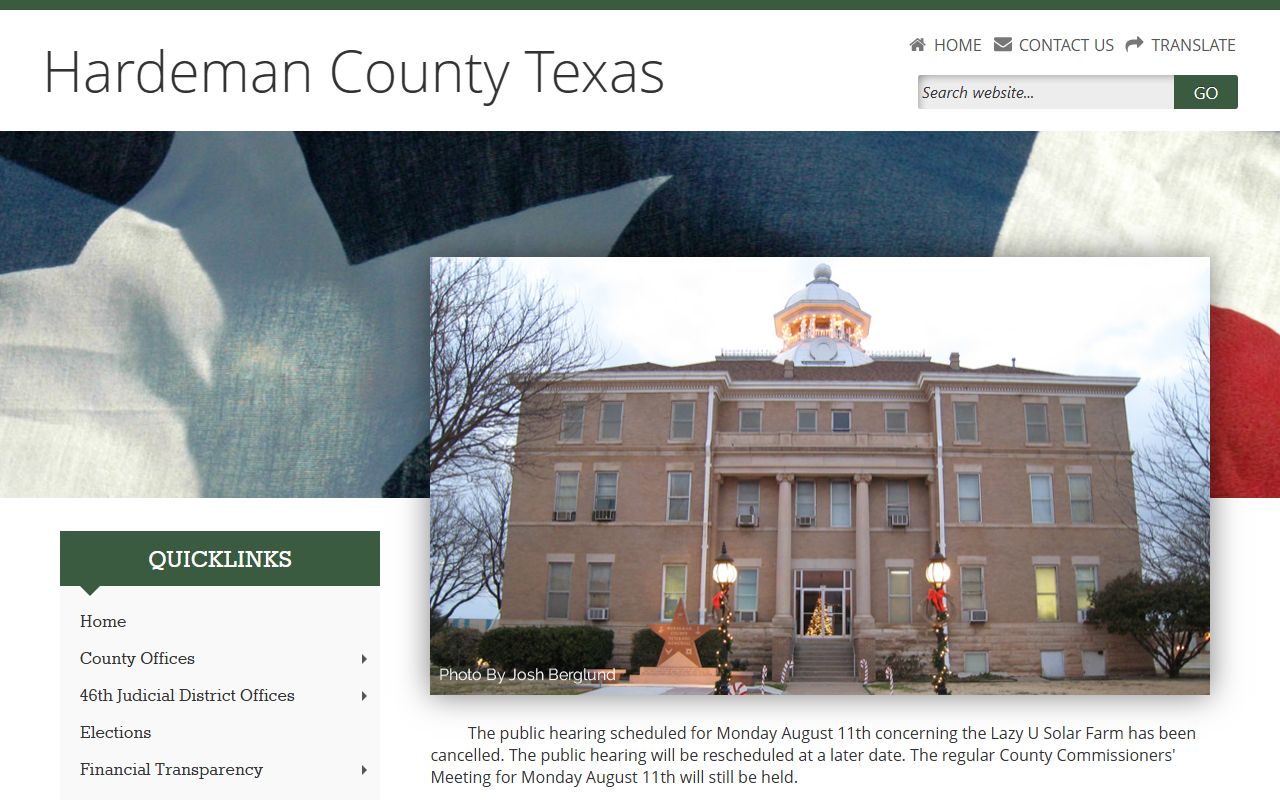
The Hardeman County Courthouse in Quanah holds deed and property records that can help trace whether land your family once owned in the area generated any funds now held by the state.
Note: Under Texas Property Code § 76.201, Hardeman County may hold small amounts of unclaimed property at $100 or less locally. Contact the county treasurer at 940-663-2901 for details.
Types of Unclaimed Property in Hardeman County
Dormant bank accounts, uncashed payroll checks, utility deposits, and insurance proceeds are the most common unclaimed property types in rural North Texas counties like Hardeman. Under Texas Property Code § 72.1015, wages and payroll become presumed abandoned after only one year of inactivity. A final paycheck that was never collected from any Quanah-area employer may already be in the Comptroller's database.
Agricultural operations in Hardeman County have generated lease payments, co-op distributions, and insurance proceeds over the years. Workers who left the county and farm families who sold their land may have unclaimed funds under names and addresses that are no longer current. Mineral royalties are also worth checking for any land with oil or natural gas history in the area. The Texas Railroad Commission at rrc.texas.gov maintains well and lease records for Hardeman County that can help you verify whether any mineral activity ties to family land.
The alternative databases page on ClaimItTexas.gov lists programs for pension funds, savings bonds, IRS refunds, and Teacher Retirement contributions that are outside the main ClaimItTexas system.
How to Claim Hardeman County Unclaimed Money
Claiming is free. Go to ClaimItTexas.gov, find the property in the results, and follow the steps. The system issues a Claim ID to track your case. Most claims process within 90 days.
You need proof of identity and a document connecting you to the property. Small claims need a photo ID and proof of address. Larger claims may require more depending on the type of asset. The documentation requirements page explains what applies to each property type. Reviewing it before uploading avoids the most common delays.
For claims on behalf of a deceased person, an Affidavit of Heirship or Determination of Heirship is typically needed. For complex estates or inherited mineral interests, probate records may apply. Call 800-321-2274 or email unclaimed.property@cpa.texas.gov for guidance on what your situation requires.
Track your claim with the claim status search and use the FAQ page for answers about $0 value listings and multi-heir situations.
Note: Texas law caps locator fees at 10% of recovered value. You can always file directly for free, so there is no reason to pay more than that amount to any third party.
National Databases for Hardeman County Residents
If you or a family member lived in other states, check national databases too. The free search at unclaimed.org covers multiple state programs at once. MissingMoney.com searches many participating states in a single free search as well.
The Texas data portal at data.texas.gov has a downloadable listing of Texas unclaimed property records you can filter and search offline by name.
Nearby Counties
All Texas counties fall under the same state unclaimed property program. If you have connections to neighboring counties, search those as well.