
Fort Worth Unclaimed Money Lookup
Fort Worth residents can search for unclaimed money at no cost through the Texas Comptroller's program at ClaimItTexas.gov. Employers, banks, insurance companies, and government agencies across Tarrant County report funds they cannot deliver, and the state holds them until the rightful owner claims them. This page explains where Fort Worth-specific property comes from, how to use the city's own unclaimed property portal, and how to file a claim through the official state process.
Fort Worth Overview
Searching Fort Worth Unclaimed Funds
Fort Worth is one of a few Texas cities that maintains its own unclaimed property portal in addition to the state program. The City of Fort Worth Finance Department operates a dedicated unclaimed property page at fortworthtexas.gov/departments/finance/unclaimed-property. This page lists funds the city holds from vendor overpayments, utility credits, and other city transactions that have not yet been claimed or transferred to the state. If you have ever paid for a city permit, service, or deposit and did not receive a refund, this page is the right place to start.
For the broader state program, ClaimItTexas.gov covers everything reported by Fort Worth businesses, healthcare systems, and financial institutions to the Texas Comptroller. The two databases are separate. Checking the city page first and then the state database gives you the most complete picture of what may be held in your name.
Tarrant County also holds some funds through the county auditor's office. The Tarrant County Auditor maintains an unclaimed funds page at tarrantcountytx.gov for county-held amounts from court deposits, jury pay, and other county operations. Under Texas Property Code § 72.101, most property is presumed abandoned after three years without owner contact. Wages and payroll go dormant in just one year under § 72.1015.
Fort Worth is in Tarrant County, and the county page has more details on county-level resources for unclaimed funds.
The City of Fort Worth's own unclaimed property page is a local resource that goes beyond what the state holds.
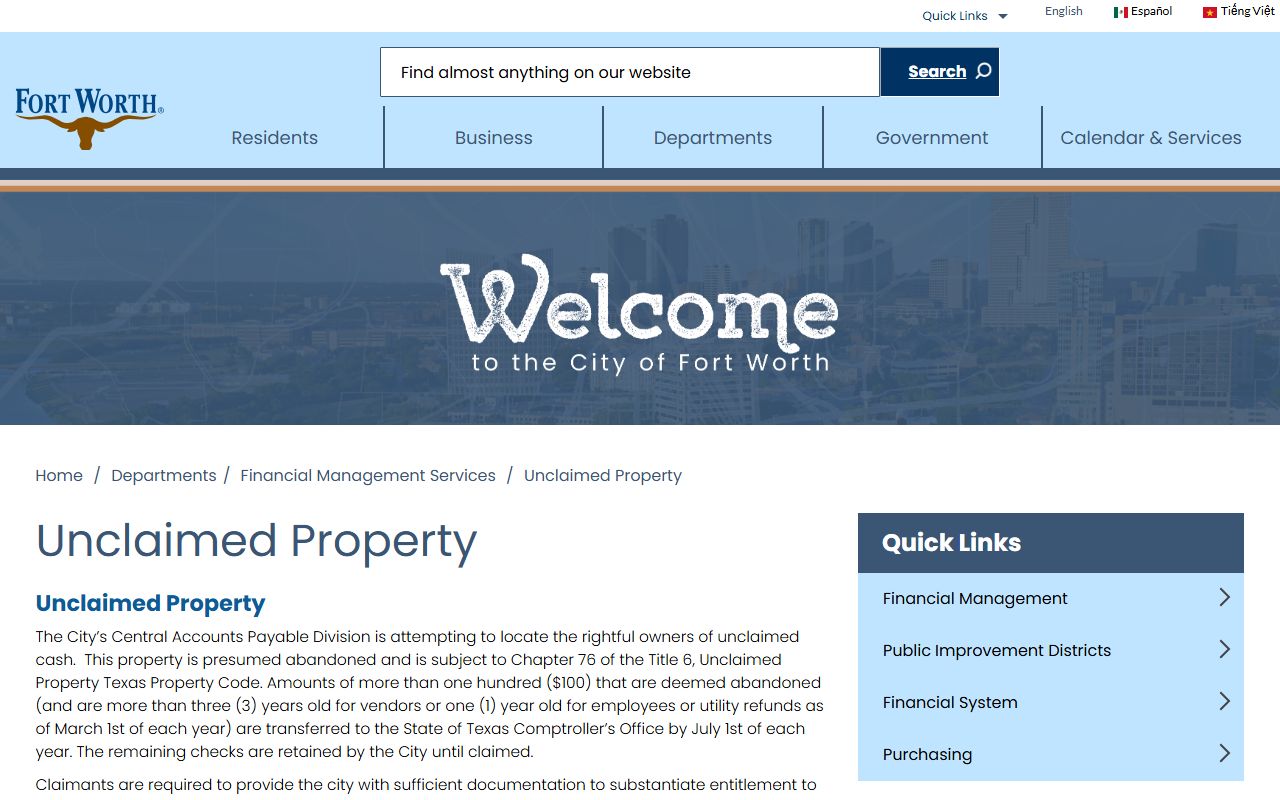
The Fort Worth Finance Department page shows how to search and claim funds held by the city directly before they transfer to the state program.
Fort Worth Local Resources
The Tarrant County Auditor's unclaimed funds listing is a key resource for anyone with ties to county government. Jury duty pay that was never picked up, court registry balances from settled cases, and overpayments on county fees all end up on this list if they go unclaimed long enough. The county page at tarrantcountytx.gov has the current listing and instructions for claiming county-held amounts.
Fort Worth ISD, Texas Christian University, and UNT Health Science Center are major local employers and institutions that generate unclaimed property. TCU handles a large volume of student financial aid and employee payroll. A student who left without updating their address may have a refund check sitting unclaimed for years. JPS Health Network, the county's public hospital system, generates patient account credits and insurance overpayments that work the same way. Run a search under your name or any relative's name who had dealings with these institutions.
Naval Air Station Joint Reserve Base Fort Worth is another source unique to this city. Military pay and benefits sometimes go unclaimed when service members reassign or separate without updating contact information. Former NAS Fort Worth personnel should run searches under any name or address they used during their service.
The Tarrant County Auditor page shows the county's own holdings separate from the state program.
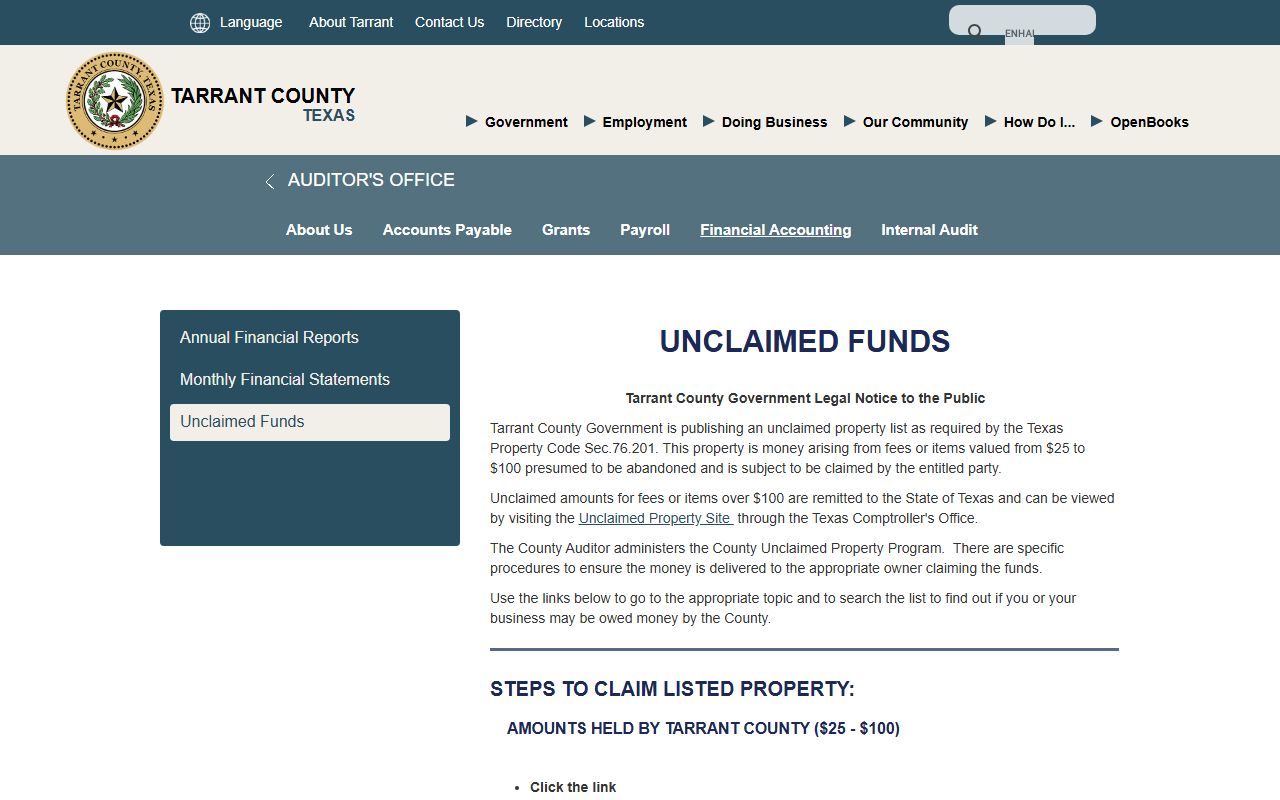
The county auditor's listing covers Fort Worth area funds that are held at the county level and have not yet transferred to the state.
Note: Texas Property Code § 76.201 allows counties to hold small amounts of unclaimed property valued at $100 or less separately from the state program. Contact the Tarrant County Auditor for details on amounts held locally under that threshold.
Types of Unclaimed Property in Fort Worth
Dormant bank accounts, uncashed payroll checks, utility deposits, and insurance proceeds are the most common types of unclaimed property in Fort Worth, as they are across Texas. The city's growth over the past decade has brought a large number of new residents, which also means more people with property still held in prior cities or states that they have not yet claimed.
Healthcare-related refunds are particularly common in Fort Worth given the size of JPS Health Network and the many private medical practices in the area. Patient account overpayments, secondary insurance refunds, and credit balances often sit unclaimed when billing addresses change. These amounts are sometimes small, but they are just as worth claiming as any other property in the system.
Fort Worth's manufacturing sector, including the General Motors assembly plant, means employee retirement plan balances and pension-related accounts also appear in the database. If you or a family member worked in manufacturing in Fort Worth and left before fully vesting or without updating your address, a search under that employer's name combined with your own may return results. The alternative databases page on ClaimItTexas.gov is the right place to look for pension fund balances that go through different programs than the main state search.
Claiming Fort Worth Unclaimed Money
The claim process runs through ClaimItTexas.gov. Find your property, select it, and follow the steps to file. You receive a Claim ID to track progress. Most standard claims take about 90 days. There is no cost to file.
The documents you need depend on the type and value of the property. A photo ID and proof of your address are enough for small claims. Larger ones may need employer records, insurance policy numbers, or bank account documentation. The documentation requirements page covers all property types. Read it before you upload anything. Wrong documents are one of the most common reasons a claim gets kicked back or delayed.
For heirship claims on behalf of someone who has died, you need to show legal standing. An Affidavit of Heirship often works for small estates. Larger or more complex situations may need full probate documentation. The Comptroller's office at 800-321-2274 or unclaimed.property@cpa.texas.gov can tell you specifically what your case needs. Fort Worth residents handling estates with business assets or real property-related accounts should call before filing.
After filing, check your status with the claim status tool any time. The FAQ page answers questions about $0 value items, stock shares, and claims that involve multiple rightful owners.
National Search Databases
Fort Worth residents who have lived in other states should also search national databases. The free tool at unclaimed.org covers many state programs at once. MissingMoney.com covers many of the same states and is also free. Both are legitimate and require no payment to search or claim.
The Texas data portal at data.texas.gov has a full downloadable listing of Texas unclaimed property that you can filter and search outside of the ClaimItTexas interface. This is useful for users who want to search by specific criteria or cross-reference large data sets on their own.

The ClaimItTexas portal covers all Texas-reported property and is the central starting point for any Fort Worth unclaimed money search.
Nearby Cities
If you have connections to nearby Tarrant County cities, those unclaimed property searches are worth running alongside the Fort Worth search.