
Find Unclaimed Money in Allen
Allen residents can search for unclaimed money held by the state of Texas at no cost through ClaimItTexas.gov. The Texas Comptroller holds funds reported by banks, employers, insurance companies, and other Allen-area businesses that lost contact with the owner. With a large corporate and retail presence in the city, Allen generates a steady stream of reported unclaimed property each year, from dormant accounts at financial institutions to uncashed payroll checks from technology and retail employers. This guide covers where to search, what kinds of property are most common, and how to file a claim.
Allen Overview
Searching Allen Unclaimed Funds
The main search tool for Allen unclaimed money is the Texas Comptroller's ClaimItTexas.gov portal. Enter your name and the system returns any property on file. No login is needed. Results show the reporting company, the type of property, and an approximate value. You can search individual names, business names, or a deceased relative's name.
All companies in Allen are required to follow the same state rules. Under Texas Property Code § 72.101, property is presumed abandoned after three years of no activity or owner contact. Once that threshold passes, the holder must turn the funds over to the Comptroller. The property stays in the program indefinitely. There is no deadline to claim it, and the state does not charge a fee at any step.
The City of Allen Finance Department manages local government accounts and may hold unclaimed utility deposits, vendor checks, or other city-issued payments separately from the state program. Contact Allen's finance office if you believe you are owed funds directly from a city department.
ClaimItTexas.gov is the fastest way to see if the Texas Comptroller is holding any Allen unclaimed property in your name right now.
The portal is updated regularly as new reports come in from Allen businesses, so checking back periodically makes sense if nothing appears on your first search.
Allen Local Resources
Allen is in Collin County, and the Collin County government in McKinney handles most official record-keeping for the area. The County Clerk's office maintains deed records, property filings, and other instruments that can help trace ownership of assets that may have generated unclaimed property. If you are researching real estate-related unclaimed funds, the County Clerk is a useful starting point.
Allen ISD, Baylor Scott & White Allen, and Collin College are among the larger local institutions that employ a significant number of Allen residents. These employers issue payroll regularly, and when employees leave without collecting final checks or have outdated mailing addresses on file, those checks can end up in the state program. Under Texas Property Code § 72.1015, unclaimed wages go presumed abandoned after just one year, which is shorter than the standard three-year rule for most other property types. If you left a job in Allen and never received your last paycheck, it may already be on file with the Comptroller.
Allen Premium Outlets and other retail businesses in the city also generate unclaimed gift cards, store credits, and customer refunds. These amounts are often small, but they add up. Searching your name and any former employer names is the quickest way to find them.
Note: Collin County may hold small unclaimed amounts separately at the county level. Contact the Collin County Auditor for information on any locally held court deposits or county-issued checks.
Types of Unclaimed Property in Allen
Allen's economy is anchored by technology companies, healthcare providers, and retail. That mix produces a wide range of unclaimed property types. Dormant checking and savings accounts are common when residents move and do not update their bank records. Uncashed payroll checks from former employers are another frequent source. Technology and corporate employers in Allen sometimes issue stock options, restricted stock units, or employee benefit payments that go unclaimed when employees leave the company and do not follow up on outstanding balances.
Insurance policy proceeds are also a significant category. Life insurance companies must report policy proceeds when the insured has died and the beneficiary cannot be located. If a family member passed away and you are not sure whether they had a life insurance policy, searching ClaimItTexas.gov under their name is worth doing. The same applies to annuity payments, pension distributions, and IRA or 401(k) rollover checks that were never cashed.
Utility and service deposits, customer refunds, and credit balances from internet and phone service providers round out the list. Allen is a fast-growing city, and with high turnover among renters and frequent moves within the area, utility deposit refunds often get lost in the shuffle.
Filing an Unclaimed Money Claim from Allen
Start the process at ClaimItTexas.gov. Locate your name in the search results, click on the property, and follow the on-screen steps. The system issues a Claim ID when you submit. Use that ID to track your case on the claim status search page. Most claims finish in about 90 days, though complex cases with multiple documents may take longer.
Every claim needs proof of identity and a document connecting you to the property. Simple claims, such as a forgotten bank account or old paycheck, usually only need a photo ID and proof of your current address. Claims on behalf of a deceased person require additional documentation, such as an Affidavit of Heirship, a death certificate, and proof that you are the legal heir. The documentation requirements page lists what each property type needs before you upload anything.
If you need help at any step, the Comptroller's office can be reached at 800-321-2274 or by email at unclaimed.property@cpa.texas.gov. Staff can clarify what documents are needed and help you avoid the most common delays.
You should also check MissingMoney.com as a parallel search. It covers multiple states and can surface property from states where you may have lived before Allen.
MissingMoney.com is a free national tool that searches multiple state databases at once and is especially useful for Allen residents who relocated from other states.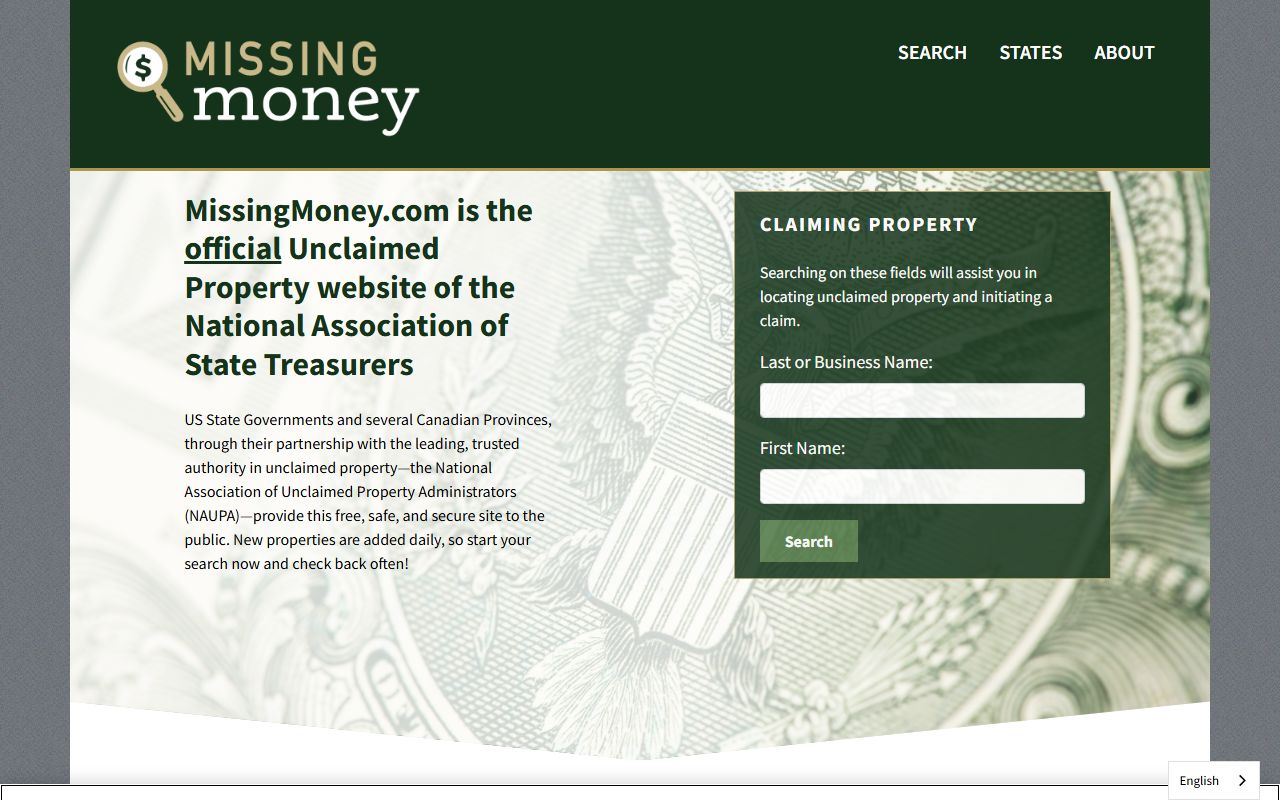
Running both the Texas state search and the national search covers more ground and takes only a few minutes.
Note: Never pay a third-party locator more than 10% of your recovered value. Texas law caps locator fees at that amount, and you can always file directly at no cost.
National Search Resources
Allen has attracted many residents from out of state, particularly those working in the Dallas-area technology and corporate sector. If you moved here from another state, any accounts or payments you left behind may still be held in that state's unclaimed property program. The free national search at unclaimed.org, run by the National Association of Unclaimed Property Administrators, lets you search multiple state databases at once without registering or paying a fee.
The Texas data portal at data.texas.gov publishes the full unclaimed property listing in a downloadable format. You can filter this data by name or county if you want to search offline or see a broader picture of what is on file in the Collin County area.
The Comptroller's alternative databases page links to separate programs for property that does not go through the state, including pension fund searches, U.S. savings bonds at TreasuryDirect, IRS refund lookup, and credit union accounts. These are worth checking alongside the main ClaimItTexas search.
Nearby Cities
All Texas unclaimed property claims go through the Comptroller at the state level. If you have connections to nearby Collin County cities, search those too.